
Materials & Circularity guide
How Do We Make a Beauty Gift Box Ribbon Removable?
A ribbon can make a gift feel considered but become hard to separate. Pulling a glued end may tear the box or leave hidden material.
We design a removable gift box ribbon as a separate component with a clear removal path. We define its job, compare attachment options and review the finished pack. We keep ease of separation distinct from any recycling or reuse claim, which needs its own evidence.
At Finer Pack, we would use these questions for beauty gift sets. Our aim is a specific attachment brief and a clear handoff to the brand’s material and label review.

What Job Does the Ribbon Actually Do?
A decorative bow and a drawer pull carry different loads. Treating them as the same part can make a removal idea unsafe or confusing.
We name the ribbon’s role before selecting an attachment. It may decorate, close, carry or pull. We ask whether the box and product remain supported after removal. We do not remove a functional part from the design without reviewing the opening and handling sequence.

We distinguish decoration from support
We begin by opening the complete gift set and following the ribbon from end to end. A bow around a lid may be decorative. A short loop inside an insert may lift a product. A ribbon that passes through side walls may act as a handle. We describe the actual job rather than relying on the supplier’s accessory name. If one strip performs two jobs, we record both. That distinction shapes when removal can happen and what the user must support first.
We then ask what holds the contents when the ribbon is absent. For a decorative wrap, the tray and box closure should still do their assigned jobs. For a lift tab, removal may leave a product difficult to reach. We would review that access separately instead of calling every detachable strip an improvement. We also consider packing. A ribbon installed before the tray goes in may be trapped later. The attachment drawing needs to show the finished state, not only a loose component on a table.
We read the r/ZeroWaste gift-packaging discussion as a collection of personal reuse habits. Contributors describe keeping gift bags, boxes and ribbons. The thread also includes a cosmetics gift-wrapping example. We use those accounts to ask whether a component can remain intact after opening. We do not claim that most beauty shoppers save ribbons, or that keeping one item proves a lower environmental impact. The useful design question is narrower: can someone separate this part without destroying the parts they want to keep?
We would write the result as a short role statement in the brief. For example, a ribbon could be a removable decorative wrap, while a separate paper tray supports the containers. That is a proposed arrangement, not a tested load rating. If the brand needs a carrying handle or a product-lifting function, we ask for the appropriate functional review. We avoid using the same appearance sample to approve both decoration and strength. Each job needs an observable acceptance decision and a named owner.
Sources for this section: Reddit: gift packaging discussion3
Related decision: Review a functional drawer pull separately
| Review point | What we record | Decision |
|---|---|---|
| Decoration | Appearance and removal order | Review without relying on it for support |
| Closure or pull | Opening sequence | Check function before removal |
| Handle or lift | Supported load and access | Request functional review |
Which Attachment Gives a Clear Removal Path?
A loose-looking ribbon may hide glue beneath the wrap. A threaded loop may also stop at an end that cannot pass through its slot.
We compare a loose wrap, a threaded attachment and a bonded end on a finished sample. We record the removal order, trapped ends, tools and remaining material. We choose the simplest option that meets the agreed function and presentation, then verify it after assembly.
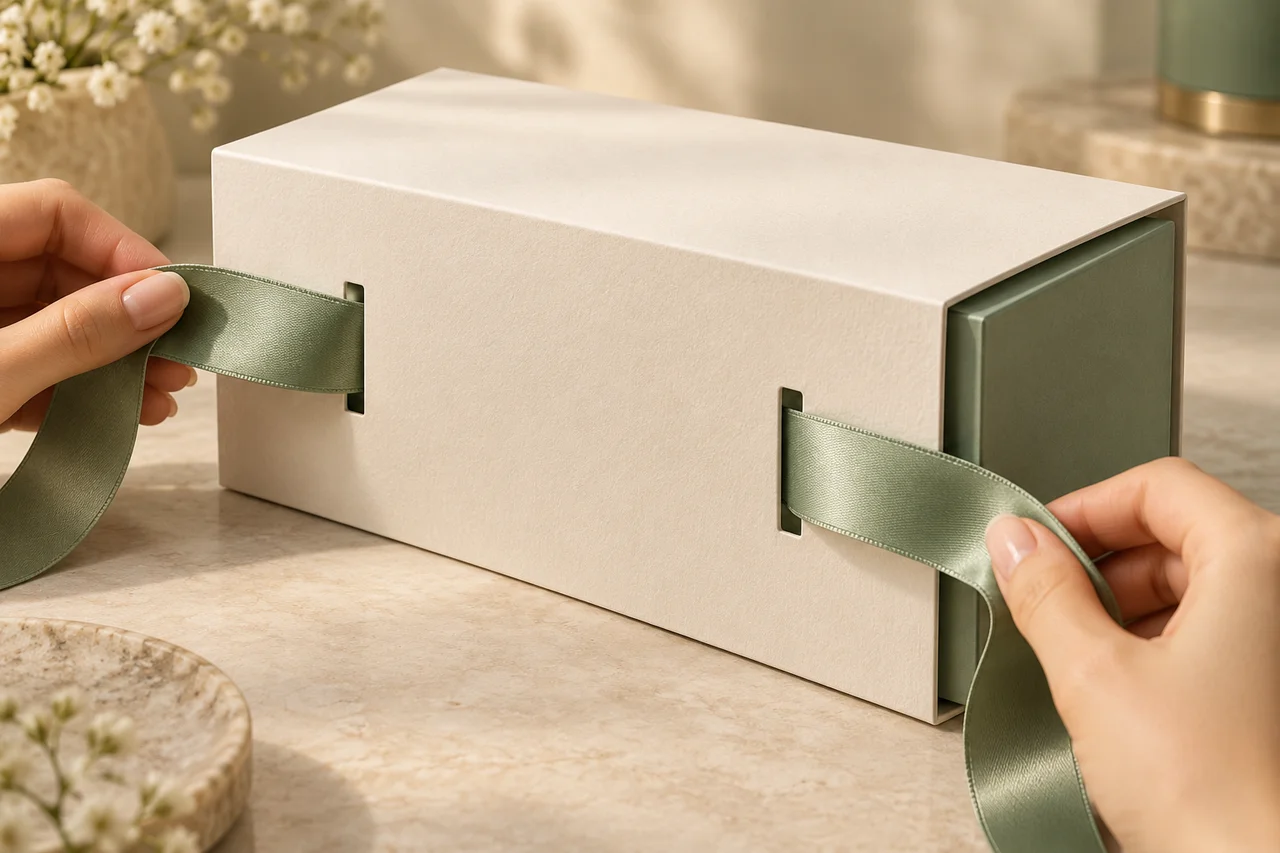
We draw the complete attachment rather than the bow
We first consider whether the ribbon needs to attach to the box at all. A separate wrap may avoid a fixed joint, but it can shift during packing or lose its intended position. We would check that behavior in the actual pack rather than assuming that a loose design is automatically suitable. We also review the packing steps needed to tie or position it. An attractive photograph does not show whether the arrangement can be repeated consistently at the intended station.
We next examine a threaded option. We show the slot path, the hidden length and the finished ribbon ends. A stiff end, knot or fitting may stop the ribbon from passing back through the opening. We ask a reviewer to follow the proposed removal path while supporting the box. We note whether the paper bends, tears or traps part of the strip. We do not assign a universal slot size or pulling force. Those details depend on the chosen ribbon, paper construction and functional brief.
We treat a bonded attachment as a separate design choice. We record the adhesive and the layers that remain together, including any hidden patch. If removal needs peeling, we inspect the exposed area after that step. A box that looks clean before opening may leave fibers or adhesive on the strip. We would not describe that arrangement as cleanly separable without seeing the result. If the brand accepts a partly bonded construction, its material record and consumer instructions should reflect that actual condition.
We compare the options using the same contents and assembly state. We keep a brief record of what the reviewer did, what remained and whether the box still served its intended next use. We also distinguish a one-time separation review from repeated opening. A component that detaches once does not prove long-term reuse. If the brand proposes a reusable gift case, we ask it to define the relevant use and review plan. This prevents a small attachment change from carrying a much larger claim than the evidence supports.
Sources for this section: Finer Pack: PPWR component records5
Related decision: Request an assembled attachment sample
| Review point | What we record | Decision |
|---|---|---|
| Loose wrap | Position after packing | Confirm presentation and handling |
| Threaded strip | Slot path and end detail | Observe complete removal |
| Bonded end | Adhesive and remaining layers | Describe actual separation |
What Can We Say After the Ribbon Is Removed?
A separated ribbon does not establish where the remaining box belongs. Broad disposal claims can hide coatings, magnets and other mixed parts.
We describe the observed separation accurately and review disposal information for the complete component set and target market. We identify coatings, adhesive, inserts and closures. We do not call a box recyclable, reusable or environmentally better merely because its ribbon can be removed.

We keep the material record and the claim review connected
We make a component list from the finished pack, including parts that do not appear in the hero photograph. The list covers the board, covering paper, tray, ribbon, closure and any separate fittings. We ask the supplier to identify the relevant materials and attachments. If a detail is unknown, we leave it open for confirmation rather than filling it with a familiar material name. A satin-like surface, for example, does not tell us the fiber composition of the strip.
We use AF&PA’s holiday recycling guidance as a US reference. It says ribbons and bows are not accepted in curbside recycling bins and advises checking local rules. That guidance helps us keep the ribbon separate in the discussion. It does not certify our remaining gift box or cover every destination market. We would check the actual construction and local collection guidance before proposing instructions. We also avoid using a general paper symbol to imply that every mixed component belongs in the same stream.
We use the FTC Green Guides summary to frame any US environmental wording. Its guidance asks for specific, supported claims rather than broad statements such as an unqualified green benefit. Our attachment review establishes only what we observed: which part came away, how it came away and what stayed behind. A claim about recycling availability, repeated use or overall environmental benefit needs evidence suited to that claim. We would send proposed wording to the brand’s responsible reviewer with the material record attached.
We finish by keeping the removal instruction consistent with the accepted sample. We ask whether the user can identify the strip and follow the sequence without guessing. If the instruction requires a tool, damage or a particular order, we record that openly. For later production, a change in adhesive, ribbon end or closure may alter the result. We keep those changes visible in the component specification and ask whether the instructions need another review. This gives the brand a clear factual basis without promising what will happen after every customer discards the pack.
Sources for this section: AF&PA: holiday paper recycling1, FTC: environmental claim summary2, Finer Pack: credible paper claims4, Finer Pack: PPWR component records5
Related decision: Review the scope of a paper-packaging claim
| Review point | What we record | Decision |
|---|---|---|
| Separation | Removed part and residue | State observed result only |
| Disposal | Market and accepted components | Check local guidance |
| Claim | Exact wording and evidence | Approve independently |
Sources and Related Reading
- 1 AF&PA: holiday paper recycling. Primary US paper-industry guidance; local acceptance and actual construction still govern.
- 2 FTC: environmental claim summary. Primary US guidance on specific and substantiated claims; not a certificate for this design.
- 3 Reddit: gift packaging discussion. Attributed personal reuse accounts; not a beauty-market survey or impact study.
- 4 Finer Pack: credible paper claims. Related guidance on the boundary of a material claim.
- 5 Finer Pack: PPWR component records. Related decision on documenting the whole packaging system.
Conclusion
We define the ribbon’s job, verify its removal on the complete pack and describe the result precisely. We support disposal claims with separate evidence.