
France Packaging Labels guide
How Should We Plan French Info-tri on Cosmetic Packaging?
A French launch can lose panel space late when the carton, bottle, pump, and sleeve are treated as one undefined package.
We map every consumer-facing component, confirm the responsible producer and approved sorting information, then reserve a stable artwork area. We check the final assembled pack, not a single flat carton, before release.
We use three practical questions to turn a French sorting-label request into a controlled packaging decision without guessing at legal scope.

Which Cosmetic-Pack Components Need Mapping First?
A front carton can look complete while a pump, cap, sleeve, insert, or bottle remains outside the team’s sorting-information brief.
We begin with a component list for the exact consumer unit. We separate the primary container, closure, label, carton, insert, sleeve, and any promotional add-on. We then ask the French producer or appointed compliance owner which information applies to that final configuration.

We map what the customer receives and separates
We start with a photographed sample, not an old artwork PDF. We place the bottle, pump, cap, label, carton, insert, sleeve, tamper feature, and leaflet on one table. We give each piece a simple component ID and note whether the customer receives it. This makes the conversation specific. A carton may be paperboard, while a pump is a mixed assembly and a label may use a different material. We do not decide the sorting message from the carton alone. France’s public Info-tri explanation describes information that guides people on sorting used everyday products and packaging. It presents the signal as a sequence that identifies the item, the parts to sort, and where to place them. That public explanation helps a packaging team understand the purpose. It does not replace confirmation from the business that places the pack on the French market or from its relevant eco-organisation. We keep that legal-role decision outside the print supplier’s assumptions.
We also separate fixed packaging from launch extras. A seasonal ribbon, sampler sachet, gift sleeve, or e-commerce overbox can change the physical system that reaches a customer. We record whether each item is part of the consumer unit, a retailer-added item, or a shipment-only item. This does not create a legal conclusion by itself. It creates a clear brief for the responsible team to review. We ask for the approved asset, version, component scope, placement instruction, and effective market. We save those answers beside the material specification. When an agency supplies a visual, we still check the die line, folds, varnish area, and final orientation. We do not redraw a regulated mark from memory. A Reddit discussion about France’s Triman and Info-tri debate reflects a practical buyer concern: country-specific pack changes can become expensive when they appear late. We treat that as community perspective. The applicable public guidance and the responsible market owner remain the authority for the pack decision.
| Component | Question for the brief | Evidence to retain |
|---|---|---|
| Primary container | Does the customer receive it with the product? | Photo, material and final SKU |
| Closure and pump | Is it a separate consumer-facing piece? | Component ID and approved scope |
| Carton and insert | Which panels and pieces form the retail unit? | Dieline and assembled sample |
| Launch extra | Is it a permanent or campaign-specific addition? | Market, timing and owner |
How Do We Reserve Artwork Space Without Late Rework?
A label asset placed after foil, claims, barcode, and legal copy can land on a fold or become too small to read on the real carton.
We reserve a protected panel after the responsible owner supplies the approved information and placement direction. We keep it away from folds, glue areas, opening tabs, and finish changes. We review it at finished size on the intended substrate before production artwork is released.
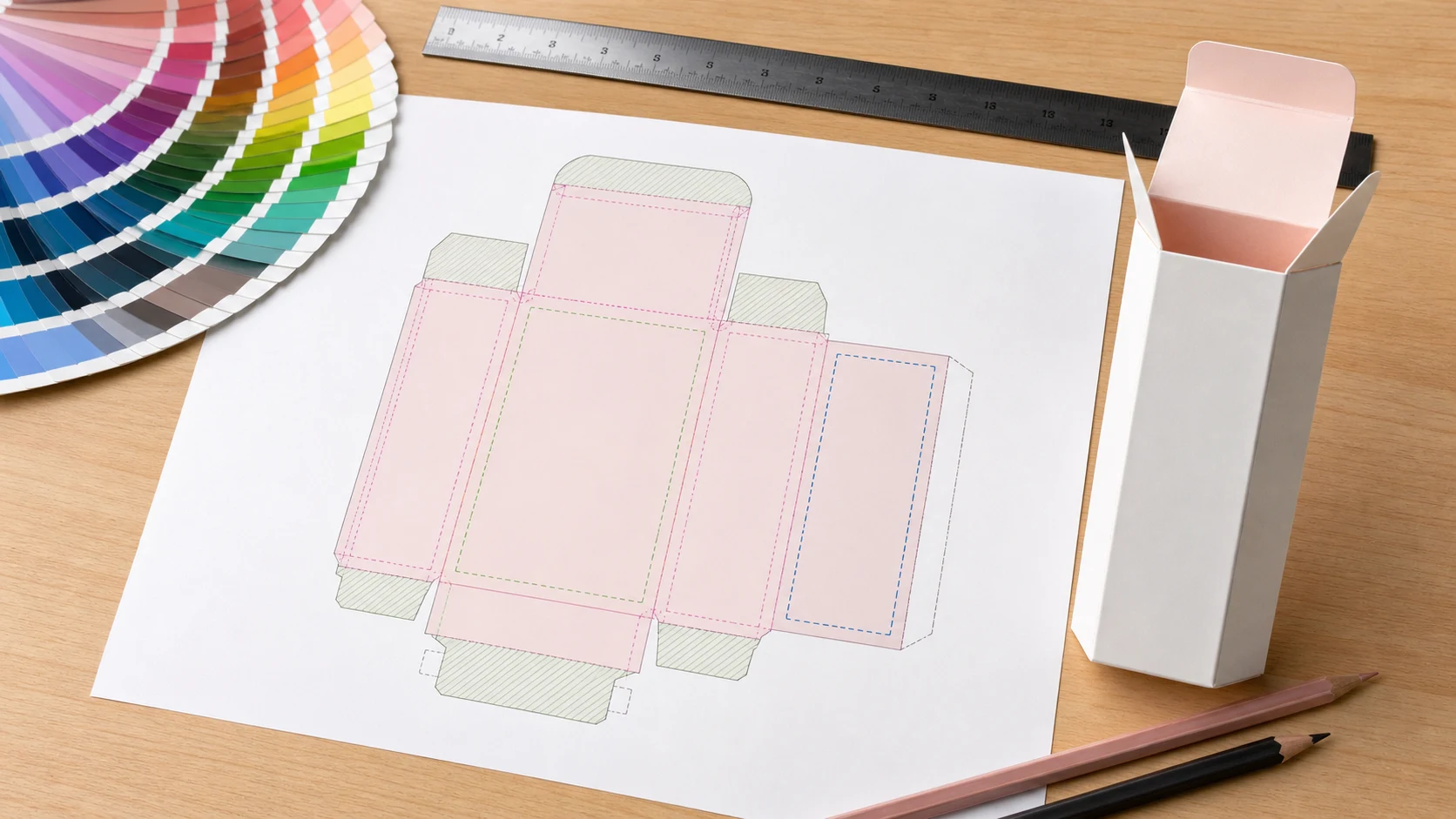
We give the information a real physical home
We begin with the approved structure. The design team needs the final dieline, finished orientation, safe area, bleed, glue flap, scores, and opening direction. We mark the candidate information panel before the team fills every surface with branding. A front-facing pack may need its main hierarchy for the product name and claims. A side panel may carry ingredients, required particulars, batch space, a barcode, or a market-specific element. We do not assume that unused white space is usable space. A narrow panel can disappear in a finger grip. A low panel can be hidden by a shelf tray. A foil field can reduce contrast. A fold can break a small symbol. The French government’s Info-tri overview explains that the signal is intended to be readily understood by the consumer, so we treat clarity as a design review question even after the scope is approved.
We make a short artwork checklist. It names the market, the component scope, the approved source file, the panel, the minimum clearance requested by the asset owner, the print method, and the proof required. We keep this checklist with the artwork version so a later carton size change cannot silently move the information. We use a paper proof at finished size when the panel is small. We also view the carton in the shelf orientation and as a customer opens it. This catches a symbol that is technically present but hidden by a tuck flap, wrap label, or assembled sleeve. The supplier should flag an impossible panel early, but the brand or responsible French operator should approve the actual information. We do not turn a packaging supplier into a legal interpreter. This division is simpler: the compliance owner confirms what belongs; the packaging team confirms that it can be printed, seen, and retained through manufacture.
| Artwork risk | What we check | Practical response |
|---|---|---|
| Fold or glue | Whether the panel crosses a score or glue flap | Move it to a stable panel |
| Low contrast | Substrate, varnish and color interaction | Proof on the intended board |
| Small format | Finished-size legibility | Test the actual carton size |
| Version drift | Market and component scope | Record approved asset and owner |
What Should We Check on the Final Cosmetic Pack?
A correct screen file can still fail the real-world check when a label wraps, a carton is packed differently, or a promotional sleeve hides the panel.
We inspect the final consumer configuration: the printed carton, container, closure, label, insert, and any sleeve or add-on. We compare it with the approved component map and artwork record. We then send unresolved scope questions back to the responsible French market owner before release.

We review the assembled system, not a digital promise
We ask for three views during approval. The first is the flat production proof. It shows print placement, folds, bleeds, and the relationship between artwork layers. The second is the assembled retail unit. It shows the panel in the orientation a shopper sees. The third is the opened unit with each component visible. We photograph these views beside the version record. We do not use a white dummy to approve contrast, and we do not use a screen PDF to approve the effect of a metallic, textured, or varnished substrate. A small physical proof can expose a hidden element or a panel that becomes distorted around a curve. When components come from different suppliers, we check that the material and SKU identifiers match the component list. The review should identify what the sample proves and what it does not prove.
We make release conditional on open questions having an owner. If a French operator changes the approved component scope, the packaging team rechecks the assembled system and the selected panel. If a marketing team adds a gift sleeve, we record whether it changes the customer-facing configuration. If a retailer adds a label, we distinguish that from the manufactured pack. These choices prevent a generic instruction from becoming an unsupported production assumption. Service-Public explains Info-tri as an aid for sorting products and daily waste. That is useful context for the final check: the team should be able to point to the pieces a customer will handle. We avoid saying that the print alone proves compliance. The printed package is evidence of execution. The legal basis, responsibility, and current market direction require confirmation by the appropriate operator and adviser. This approach keeps artwork, sample approval, and compliance ownership connected without overstating what a carton maker can certify.
| Final check | What it confirms | Escalation trigger |
|---|---|---|
| Flat proof | Placement and print layers | Mark crosses a score or bleed |
| Assembled carton | Visibility in selling orientation | Sleeve or flap hides the panel |
| Opened unit | Component map against real pack | New closure, label or insert |
| Release record | Approved version and market owner | Scope or responsibility is unclear |
Sources and Related Reading
- 1 Folding cosmetic cartons. Internal route for retail-carton structure and artwork planning.
- 2 Cosmetic packaging manufacturing. Internal route for proof, production, and release planning.
- 3 Contact Finer Pack. Internal route for sharing the final product, component, and market brief.
- 4 French public Info-tri overview. French government explanation of the consumer sorting-information sequence.
- 5 French Environment Code materials. Official French legal text resource for waste and sorting-information context.
- 6 Reddit France Info-tri discussion. Attributed community discussion about practical cross-market packaging change; not legal advice.
Conclusion
We map the whole cosmetic pack, reserve an approved information panel early, and check the assembled French-market configuration before release.