
Sampling & Quality guide
How Do We Check Every Item in a Beauty Advent Calendar?
An elegant calendar loses its purpose when a compartment is empty. A final glance at the closed box cannot show what went inside.
We use a beauty advent calendar packing checklist that links each compartment to its approved contents. We check identity, quantity and placement before closing, then hold any mismatch for review. We keep this completeness check separate from product safety, appearance and transit approval.
At Finer Pack, we would build the packing brief around these three questions. The aim is a repeatable review, with clear limits on what each check can establish.
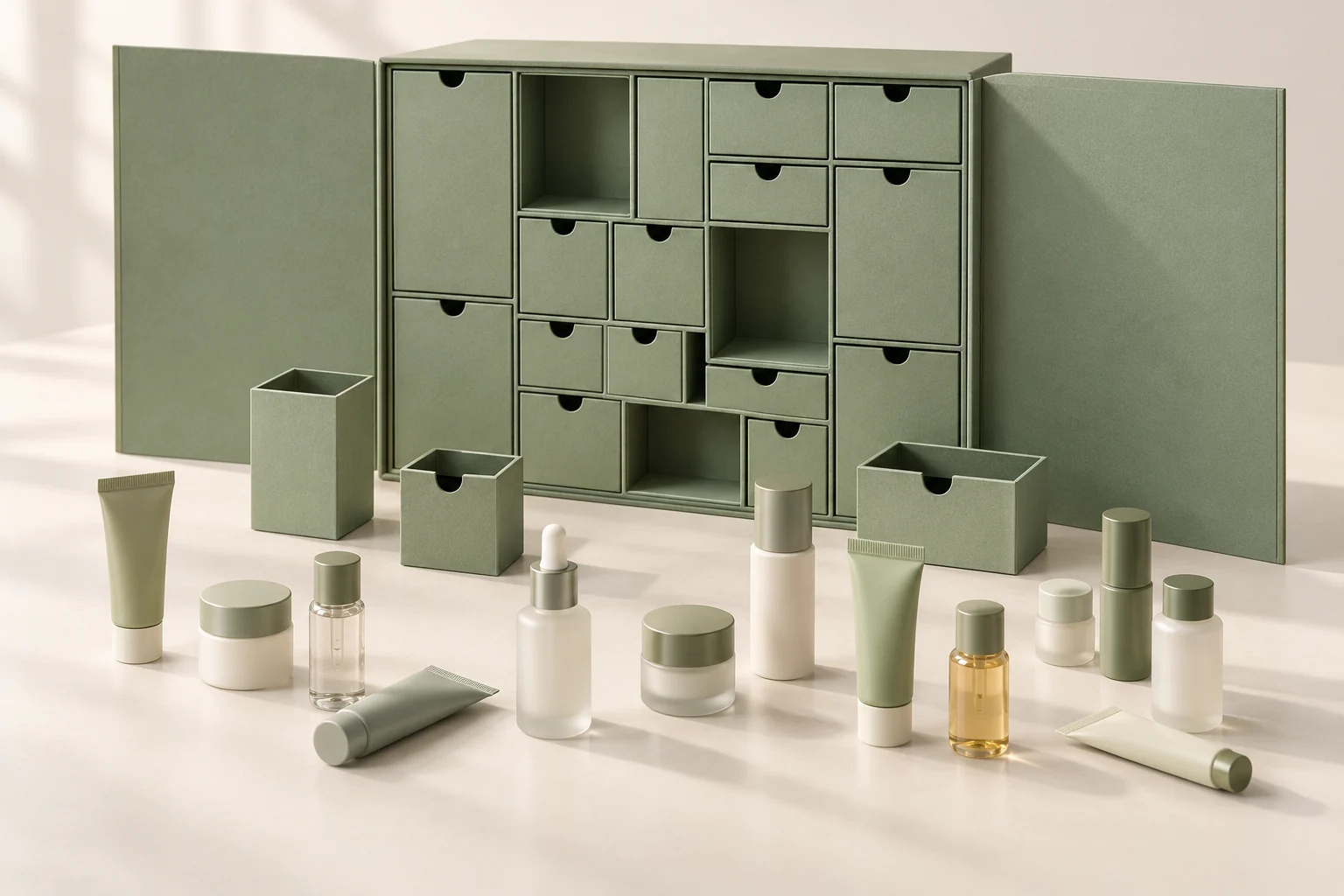
What Belongs in Each Calendar Compartment?
A product list alone leaves room for mistakes. Similar tubes or a late assortment change can put the right item in the wrong place.
We create one approved compartment map. Each position names the product version, quantity, orientation and any separate insert or card. We date the map and identify who can approve changes, so a packer does not need to guess from a marketing image.

We turn the assortment into a physical map
We begin with the complete offer that the brand intends to sell. A calendar position can contain one item, several small items, or an item with an information card. We write that detail beside the position rather than assuming that the number of doors equals the number of products. We also separate a product name from its version. A mini cleanser and a full-size cleanser may share a design while needing different cavities. The approved map should make that difference visible to the person filling the box.
We then build a complete reference sample with the actual intended containers. We record which face points up and how the product sits. We include any paper wrap or divider that affects placement. If a compartment holds two items, we show both in the reference. A photograph can help explain the arrangement, but it does not replace the written quantity. We keep a copy at the packing station and give the same version to the person checking the finished set.
We use current brand examples only to understand the format. Yepoda presents its 2026 calendar as a beauty case with daily contents. That example shows why the outer object and the assortment are separate design questions. It does not tell us how another brand should fill its calendar. Our map comes from the approved offer, not a competing product page. We also avoid copying promotional value claims into an engineering specification. The useful inputs are the real containers, their count and their intended positions.
We make late changes visible before anyone continues packing. If a brand substitutes a tube, changes a product size or adds an accessory, we revise the map and check the affected cavity. We remove the outdated reference from the active station while retaining it in the change record. We also ask whether outer artwork or the consumer contents list needs review by the brand. This keeps the packaging team within its role and prevents an unapproved assortment from becoming the reference simply because it arrived last.
Sources for this section: Yepoda 2026 calendar1, Pre-production sampling guide4
Related decision: Choose the right pre-production sample
| Map field | What we specify | Why it matters |
|---|---|---|
| Position | Compartment identifier | Links the item to a place |
| Contents | Product version and quantity | Distinguishes similar-looking units |
| Placement | Orientation and packing aids | Makes the arrangement repeatable |
When Should We Check the Fill Before Closing?
A missing item can disappear behind a flap. Opening every finished box later adds handling and can disturb an otherwise tidy presentation.
We place the identity and count check while the contents are still visible. We define a consistent filling order, a separate check step and an exception area. We do not use a closed-box weight alone as proof that every intended item is present.

We make the checkpoint fit the packing sequence
We plan the filling sequence around the box construction. A drawer calendar may allow a check before each drawer enters its sleeve. A door calendar may need a check before a rear panel closes. We choose a point where the person can see the item and compare it with the map. We also consider the packing table itself. Mixed products should not crowd the active station in a way that makes one similar tube easy to substitute for another. The sequence should reduce opportunities for confusion.
We distinguish three observations: the item is present, it is the approved item, and it is in the approved position. A tick for presence does not establish identity. A complete product count does not establish the intended reveal order. We would record those decisions separately in a simple station sheet. The team also needs a clear rule for an interrupted pack. If someone leaves midway through filling, the next person should know whether to restart the check or continue from an identified point.
We read a missing-item complaint in an r/BeautyBoxes calendar-arrival discussion as a reason to ask better questions. It is a customer account, not independent evidence about the cause or frequency of packing errors. We cannot tell from that thread whether filling, later handling or another event caused the reported problem. We can still use the concern to define our own checkpoint. Our proposed process should establish what was observed before the box closed, rather than relying on the shopper to discover the contents later.
We may include a weight comparison if the brand has established a suitable method, but we treat it as an additional signal. Different contents can have similar weights, and packaging variation can affect the total. We do not invent a universal tolerance or claim that a scale identifies every missing product. For production quantities, we agree the inspection scope and response to a failure with the responsible quality team. That decision belongs alongside the sampling and acceptance plan, with the limits stated clearly.
Sources for this section: Reddit: calendar arrival discussion3, AQL inspection planning5
Related decision: Separate inspection scope from a promise of zero defects
| Check | Question | Record |
|---|---|---|
| Presence | Is the intended quantity visible? | Count against map |
| Identity | Is this the approved product version? | Product reference |
| Position | Is it placed in the intended compartment? | Position confirmation |
How Do We Handle a Missing or Misplaced Item?
Quietly fixing one box can hide a wider mix-up. Without an exception record, the next pack may repeat the same problem.
We hold the affected set, record the mismatch and check related work before release. We correct against the approved map, repeat the affected checks and retain the result. We keep completeness, appearance and transport observations separate so one pass does not imply another.

We keep the discrepancy and the correction visible
We give an incomplete or uncertain set a clear place away from accepted work. The record identifies the map version, affected position, observed item and intended item. We also record whether the box was open or already closed when the issue appeared. That detail helps the team understand what it can still inspect without adding damage. We would not ask a packer to decide alone whether an unclear substitution is acceptable. The brand owner or the named quality contact needs to resolve an assortment question.
We then define the boundary of the review. A single misplaced unit does not prove that every set is wrong, but it also does not justify checking only that one unit. We look at the practical context: the products available at the station, the last confirmed reference and any recent change or interruption. The responsible team decides which related packs need review. We record that scope rather than making an unsupported statement that the problem is isolated. A correction should leave a useful trail for later questions.
We repeat the relevant checks after correction. Reopening can mark a flap, loosen a drawer or disturb a paper wrap, so restoring the contents is only part of the work. We review the presentation against its separate acceptance reference. If the handling changes the final packed configuration, we ask the packaging specialist whether the transport review remains applicable. ISTA separates different kinds of packaged-product tests and distribution simulations. A count check is useful, but it does not replace the procedure chosen for a shipment.
We finish with a release record that a second person can understand. It identifies the approved contents map, the inspection method, unresolved issues and the decision owner. We retain a representative completed pack where the brand requires one. For a later reorder, we compare the new assortment and packaging parts with that reference before using the old checklist. This makes the checklist a controlled working document rather than a one-time form. We can then discuss exactly what was checked without promising that the process eliminates every possible error.
Sources for this section: ISTA procedure overview2, AQL inspection planning5
Related decision: Review a drawer gift-box structure
| Exception step | Useful evidence | Decision owner |
|---|---|---|
| Hold | Affected set and map version | Packing lead |
| Review scope | Related work and recent changes | Quality contact |
| Release | Correction and repeat-check result | Named approver |
Sources and Related Reading
- 1 Yepoda 2026 calendar. Primary brand example of a daily beauty assortment and retained outer case; not a packing-process standard.
- 2 ISTA procedure overview. Primary test-scope reference. Completeness inspection is separate from packaged-product transport testing.
- 3 Reddit: calendar arrival discussion. Attributed historical community clue about reported missing contents. Cause and prevalence are unverified.
- 4 Pre-production sampling guide. Internal guide to matching a sample to the decision being approved.
- 5 AQL inspection planning. Internal guide to inspection scope and acceptance limits; no zero-defect guarantee.
Conclusion
We make calendar completeness visible before closing: one approved map, a clear fill checkpoint and a recorded response when contents do not match.