
Package testing guide
When Should We Retest a Cosmetic Packaging System After a Change?
A new pump, insert, bottle supplier, carton board, or shipping route can look minor on a drawing while changing how the complete beauty pack performs.
We reopen packaging review when a product, package, or process change could affect performance. We record the change and risk, then test the complete packaged product under agreed conditions. We do not treat an old approval as proof for a changed bottle, closure, insert, carton, or distribution path.
These three questions help us connect a change record to the right sample, test scope, and release decision without claiming a universal test result.

Which Packaging Changes Should We Reopen?
A component swap can change fit, load, opening, leakage risk, or transit behavior even when the carton dimensions stay the same.
We reopen the review for changes to the product, package, or process that could affect performance. ISTA lists examples including product dimensions or materials, package configuration, components, closures, labels, filling, and distribution systems.

We record the change before we call it minor
We begin with a simple change record. We name the original approved component and the proposed component. We include the bottle, jar, tube, pump, dropper, cap, liner, label, carton board, insert, master carton, packing method, and route when they are relevant. Then we ask what the new part can change. A pump can alter closure torque, height, leakage path, and the way a carton supports the shoulder. A new bottle supplier can alter thread geometry, weight, wall thickness, or filling behavior. A thinner carton board can change stack strength and opening feel. A revised insert can change movement, breakage risk, and how a customer removes the product. We do not need to predict every failure. We need a clear reasoned list of which performance points might move. That list helps the technical team select a focused review instead of treating the old approval as a blanket approval for every later substitution.
ISTA's guidance on retesting says tests should be repeated periodically or as necessary to maintain quality characteristics on arrival, and it says tests must be repeated when a product, package, or process change can affect performance. The same guidance lists configuration, size or weight, materials, components, closures, labels, filling, and distribution as examples to track. We use that official guidance as a decision framework, not as a claim that every cosmetic pack needs the same test protocol. The brand and technical owners choose the relevant scope. Our packaging record makes that choice visible. We also identify unchanged controls. If the bottle and pump remain the same but the shipper changes, we keep the primary-pack information but focus the review on retention, movement, and distribution. If the closure changes, we retain the shipping configuration and focus the sample review on the closure and complete pack.
| Change type | What can move | First review question |
|---|---|---|
| Closure or pump | Fit, opening, leakage path, and height | Does it change the primary-pack interface? |
| Bottle or jar | Weight, thread, wall, and dimensions | Does the approved closure and insert still fit? |
| Carton or insert | Protection, movement, and stacking | Does the product remain secured in the real pack? |
| Filling or route | Handling and distribution exposure | Does the approved test condition still represent launch handling? |
What Should a Retest Represent?
Testing a loose closure or one board coupon cannot show how a filled cosmetic pack behaves inside its carton, insert, shipper, and route.
We test the complete packaged product that matches the decision. ISTA states that its procedures are intended for a specific packaged-product system and are not intended to approve or certify an individual packaging material.
We build the sample around the real launch system
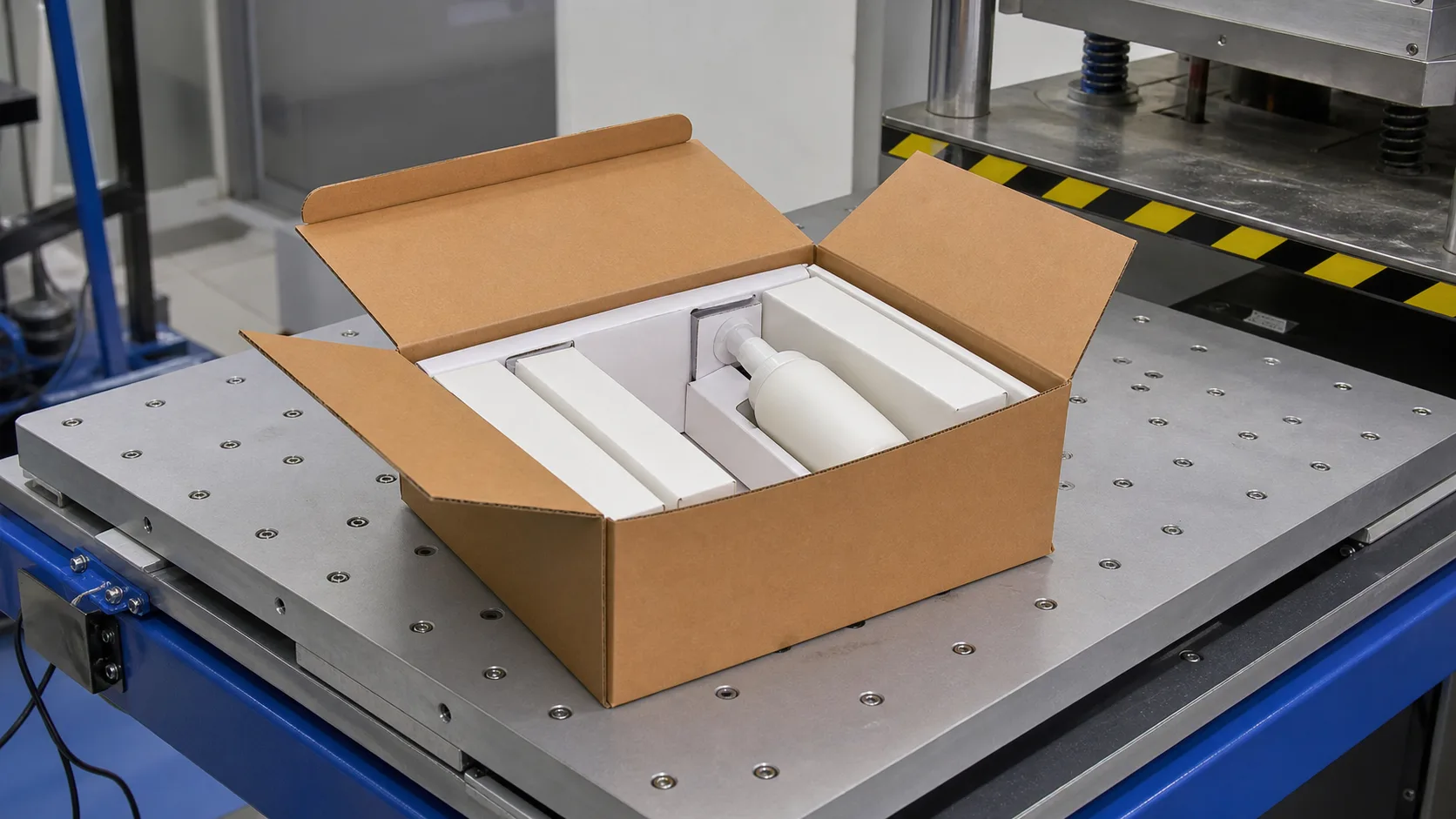
We define the sample before we select a test. We include the product or an agreed representative fill, the primary container, closure, label, carton, insert, master shipper, and any dunnage or protective element that will launch together. We record the orientation, pack count, distribution channel, and the version of each component. A material sample can answer a material question, but it cannot prove that a filled pump bottle stays aligned inside a carton after parcel handling. A closure sample can show fit, but it cannot prove how the closure interacts with an insert or shipper. We therefore make the complete system the starting point. We then state what the sample can and cannot prove. A short bench inspection may show fit and opening. A distribution simulation may address agreed handling hazards. A formula-specific compatibility or stability program belongs to the responsible product technical team and needs its own defined conditions.
ISTA explains that its test procedures are for a specific packaged product and package, rather than approval or certification of one material. Its 3A overview describes a general simulation test for individual packaged products shipped through a parcel delivery system. We use those sources to avoid a common sourcing shortcut: buying a board, bottle, or insert because it passed an unrelated test. The test sample should reflect the actual launch configuration and the question the buyer needs answered. We also define acceptance before the sample is handled. That may include intact closure, no visible leakage, controlled movement, product access, carton condition, or other project-specific observations. We do not invent a universal pass threshold for cosmetics. We write the agreed criteria, apply them to the sample, and keep the result tied to the component versions that were actually reviewed.
| System element | Why it belongs in the sample | What it helps assess |
|---|---|---|
| Product and primary pack | Weight, geometry, closure, and fill affect behavior | Fit, access, and primary-pack observations |
| Carton and insert | They control retention and presentation | Movement, contact points, and removal |
| Shipper and dunnage | They shape distribution exposure | Protection in the intended outbound configuration |
| Route definition | Handling differs by channel | Whether the chosen condition matches the actual launch path |
How Do We Release a Changed Packaging System?
A vague approval can let a changed package reach production without anyone knowing which version was reviewed or which risk was accepted.
We release only after the sample, acceptance points, result, and component versions are recorded. We classify the result as approved, approved with a documented limit, or not approved, then reopen the decision when another relevant change follows.

We turn the result into a repeatable record
We make the release record short enough to use. It identifies the SKU, product state, component versions, carton and insert revision, shipper setup, sample date, review condition, acceptance points, observations, photos, and decision owner. We avoid a generic phrase such as passed testing when the review only assessed a closure fit or a short transit check. Instead, we name the evidence: the changed pump locked into the named bottle, the carton held the agreed sample, the insert kept the product in position, or the observed condition met the project criteria. If an issue appears, we connect it to a cause where possible and change one variable at a time. A tighter insert, different pump, and new carton board should not all change in the same next sample if the team needs to know what improved the outcome.
We also set a retest trigger for the next change. If a supplier changes a closure resin, bottle thread, carton caliper, label stock, application method, or shipping configuration, the record tells the team what review to reopen. A Reddit packaging discussion about ISTA testing stresses that teams need their own success criteria and that home checks do not replace every laboratory capability. We use that as attributed practitioner perspective, not as a standard or a cost claim. The useful lesson is that the buyer should define what matters before running a test. We keep the system simple: record the change, define the sample, agree the acceptance points, inspect or test under the right conditions, and retain the decision. That sequence makes a later reorder or supplier substitution easier to evaluate without overstating what an earlier sample proved.
| Release record | What we retain | Why it matters |
|---|---|---|
| Version list | Product, closure, carton, insert, and shipper | Shows exactly what the review covered |
| Acceptance points | Agreed project-specific observations | Prevents a vague pass statement |
| Result | Approved, limited approval, or not approved | Keeps the risk decision visible |
| Next trigger | Relevant component or route changes | Tells the team when to reopen the review |
Sources and Related Reading
- 1 Printed e-commerce mailers. Internal options for the outer shipping layer of a cosmetic package system.
- 2 Finer Pack capabilities. Internal sampling and packaging-development context.
- 3 Start a package-test brief. Internal route for sharing a product, changed component, route, and sample question.
- 4 ISTA retesting guidance. Official ISTA guidance on retesting when product, package, or process changes can affect performance.
- 5 ISTA testing procedures. Official ISTA overview of packaged-product test procedures.
- 6 ISTA Procedure 3A overview. Official ISTA overview of a general simulation test for individual parcel-delivery packaged products.
- 7 Reddit packaging-testing discussion. Attributed practitioner discussion about defining success criteria and the limits of informal package checks; not a factual authority.
Conclusion
We record the change, review the real complete system, and retain a precise release decision so the next component change has a clear starting point.