
Structure guide
How Do We Pack a Travel-Size Beauty Set for Retail?
Travel-size beauty set packaging can look generous in a large carton but become wasteful, loose, or confusing when the pack does not fit the real travel routine.
We start with the exact travel-size containers and the intended sales or gift route. We use the smallest structure that protects and identifies the set, keep removal simple, and review the complete packed configuration before final artwork.
We use the next three questions to make travel-size beauty set packaging practical for the person who opens it and honest about what a secondary carton can prove.
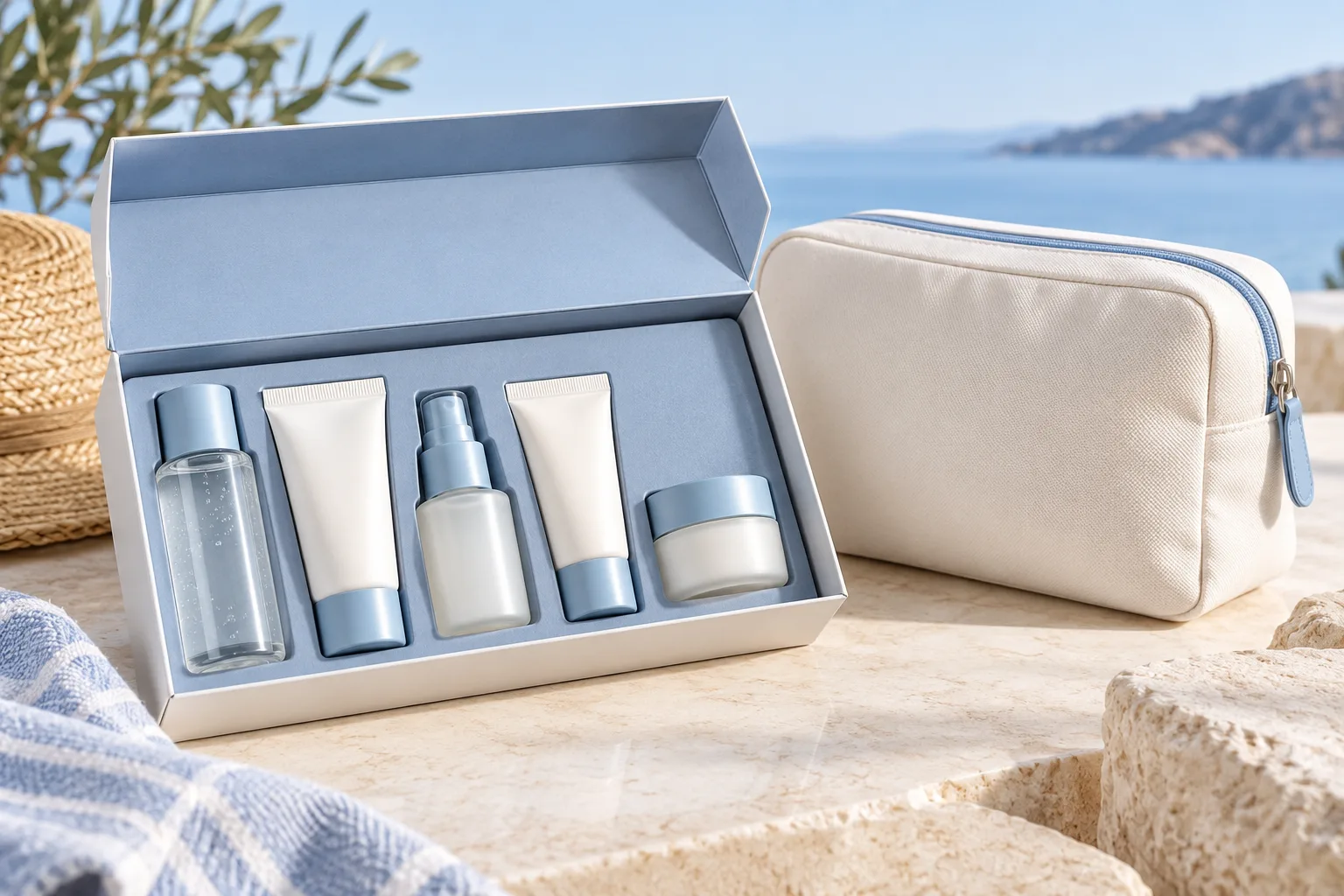
Which Containers Belong in the Travel Set?
A set described as travel-size can mix containers with different heights, closures, and label needs, making a standard insert unreliable.
We list every finished container, cap, label zone, filled weight, and intended position before selecting the carton. We do not assume an outer box makes a primary package suitable for carry-on rules, leakage prevention, or any market requirement.
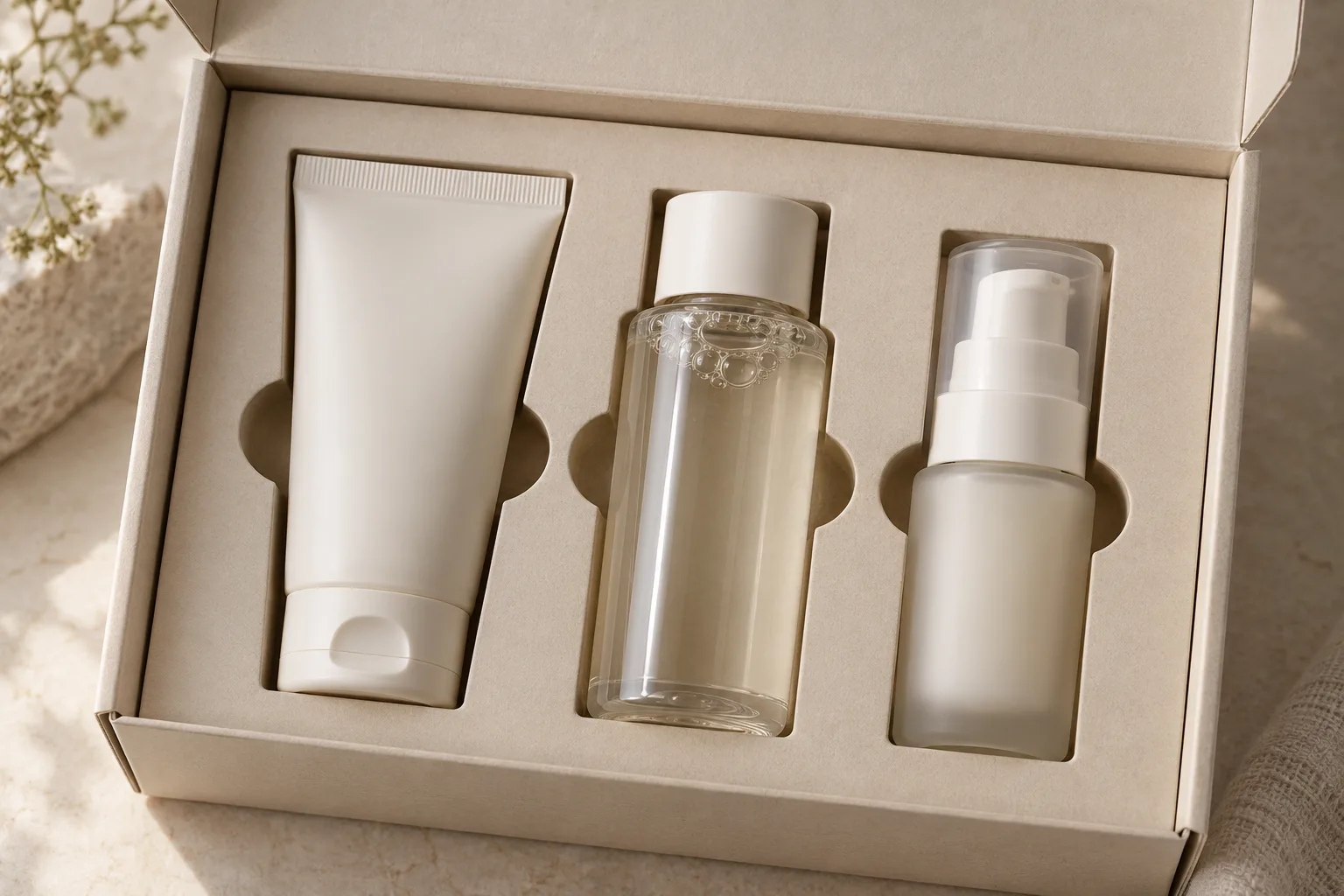
We define the physical set before we style it
We ask the brand to show the actual products that will go inside. A travel-size tube may flex. A mini bottle may have a taller cap than the drawing shows. A jar may need a different lift point from a pump bottle. The simplest way to avoid a false fit is to place all finished containers together, measure the real envelope, and note where labels, shoulders, caps, and openings sit. We also define whether the set is a retail purchase, a promotional gift, a hotel amenity format, or a direct-to-consumer add-on. That use changes the information, packing, and presentation questions.
TSA guidance for passengers sets a liquids, aerosols, gels, creams, and pastes rule for carry-on bags in the United States, but it does not certify a cosmetic box or guarantee a journey. We therefore avoid calling a carton TSA-approved. The responsible brand verifies current route-specific rules and the primary containers. Our secondary-pack task is more focused: keep the intended set orderly, protect visible surfaces, allow a person to identify and remove each item, and carry only the information that the artwork owner has approved. A Reddit travel discussion notes that some people avoid decanting while others depend on small containers. That is a real consumer conversation, but it is not a percentage or a design rule.
We use it as a prompt to decide whether this brand is offering a ready-made mini size, a refillable format, or a presentation set. Then we build around that decision instead of treating all small beauty products as interchangeable.
Sources for this section: TSA carry-on liquids guidance1, Reddit travel beauty-packing discussion3, Finer Pack folding cosmetic cartons4, Contact Finer Pack6
| Container fact | Why we capture it | Decision it supports |
|---|---|---|
| Filled dimensions | Sets carton and cavity envelope | Compact outer size |
| Closure and cap | Can affect height and contact | Orientation and divider need |
| Label zone | Keeps product identification visible | Cavity and panel layout |
| Set purpose | Changes information and presentation | Retail, gift, or add-on format |
How Do We Keep a Small Set Clear and Easy to Open?
When mini products sit tightly in a decorative tray, a customer can damage labels or empty the whole box just to reach one item.
We give each item a clear position, practical lift space, and a stable relation to the card or carton copy. We use an insert only when it controls a real movement or organisation risk, not as empty visual volume.
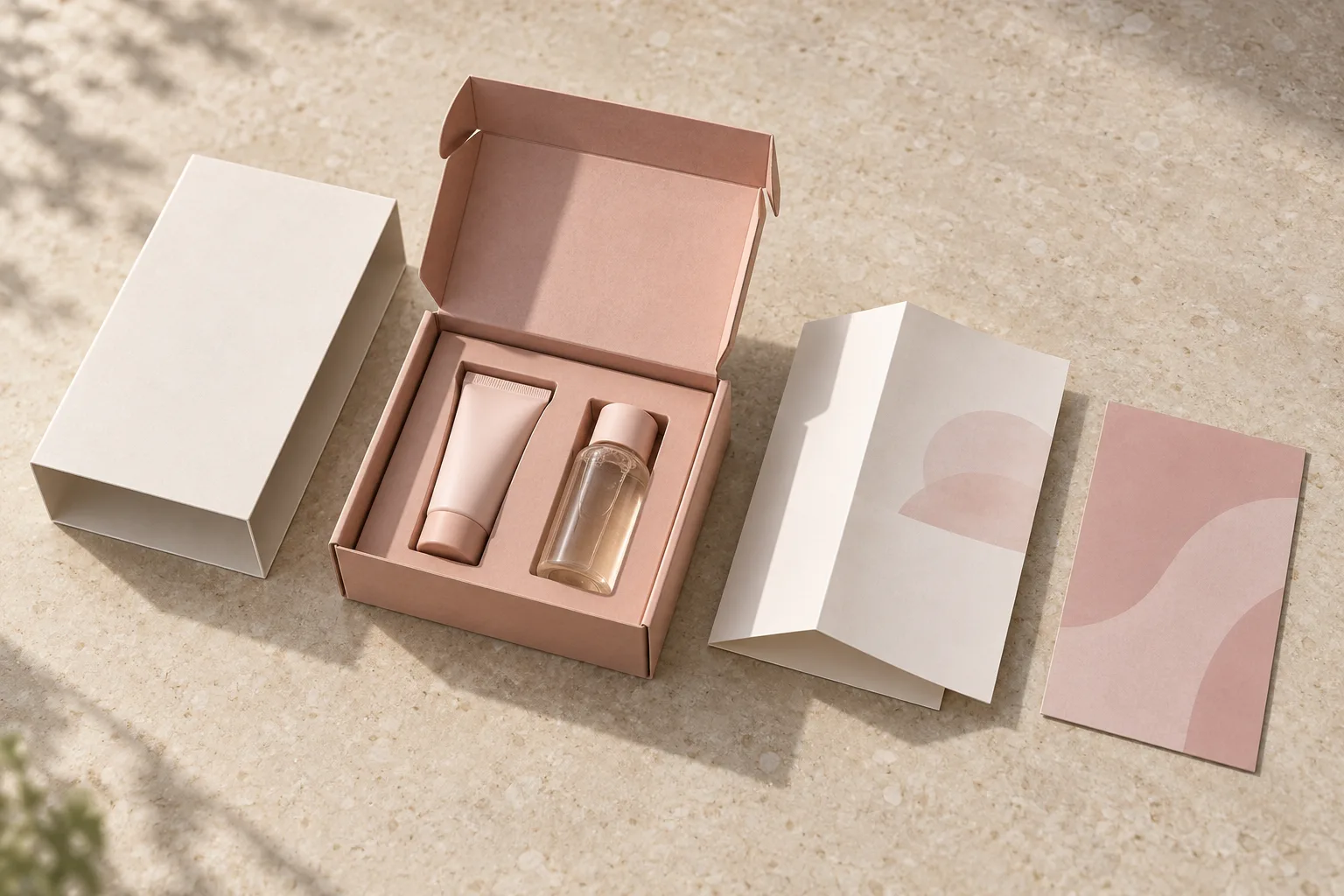
We make compact space work harder
We begin with the opening path. A person sees the outer carton, opens the flap or drawer, reads the first information layer, and lifts one product. That path should be obvious without an instruction sheet explaining where to pull. We use a simple tuck carton when the containers already sit securely and the set is small. We add a paperboard insert or divider when products can collide, turn, obscure one another, or become difficult to remove. The insert needs enough contact to control movement but enough clearance for normal fingers. We test it with the real products rather than with empty cylinders. We also choose a clear order.
The tube, bottle, jar, or stick can follow a routine, a product family, or a size hierarchy. The card and printed carton should match that physical order. Amazon search and keyword tools surface language such as travel size bottles, airless containers, and refillable pump bottles. That is marketplace terminology, not verified demand or a claim that Finer Pack sells every primary container format. It helps us phrase the buyer problem precisely: a compact set needs a stable container plan before it needs a larger decorative box. We avoid making the carton look larger than the contents through false bottoms or unnecessary voids.
Instead, we use a proportionate structure, honest product information, and a removable insert where it has a clear job. If the set needs a premium gift reveal, we sample that experience after the product fit is already stable.
Sources for this section: Amazon airless-container keyword page2, Finer Pack folding cosmetic cartons4
| Design choice | When it helps | Question to ask |
|---|---|---|
| Simple folding carton | Stable small set | Do products stay ordered without a tray? |
| Paperboard insert | Controls contact or turning | Can each item still be lifted? |
| Card or sleeve | Adds set information | Does it match the physical order? |
| Larger gift box | Supports a defined presentation goal | Does it add a real benefit? |
What Should We Review Before the Travel Set Ships?
A compact mockup can hide a loose cap, crushed label, awkward opening, or a carton that no longer closes once the finished items and card are inside.
We review the actual packed set: filled containers, caps, labels, insert, card, closure, and any outer protective layer. We document what the sample shows and leave formal leakage, transport, and route compliance to the appropriate owner or test method.
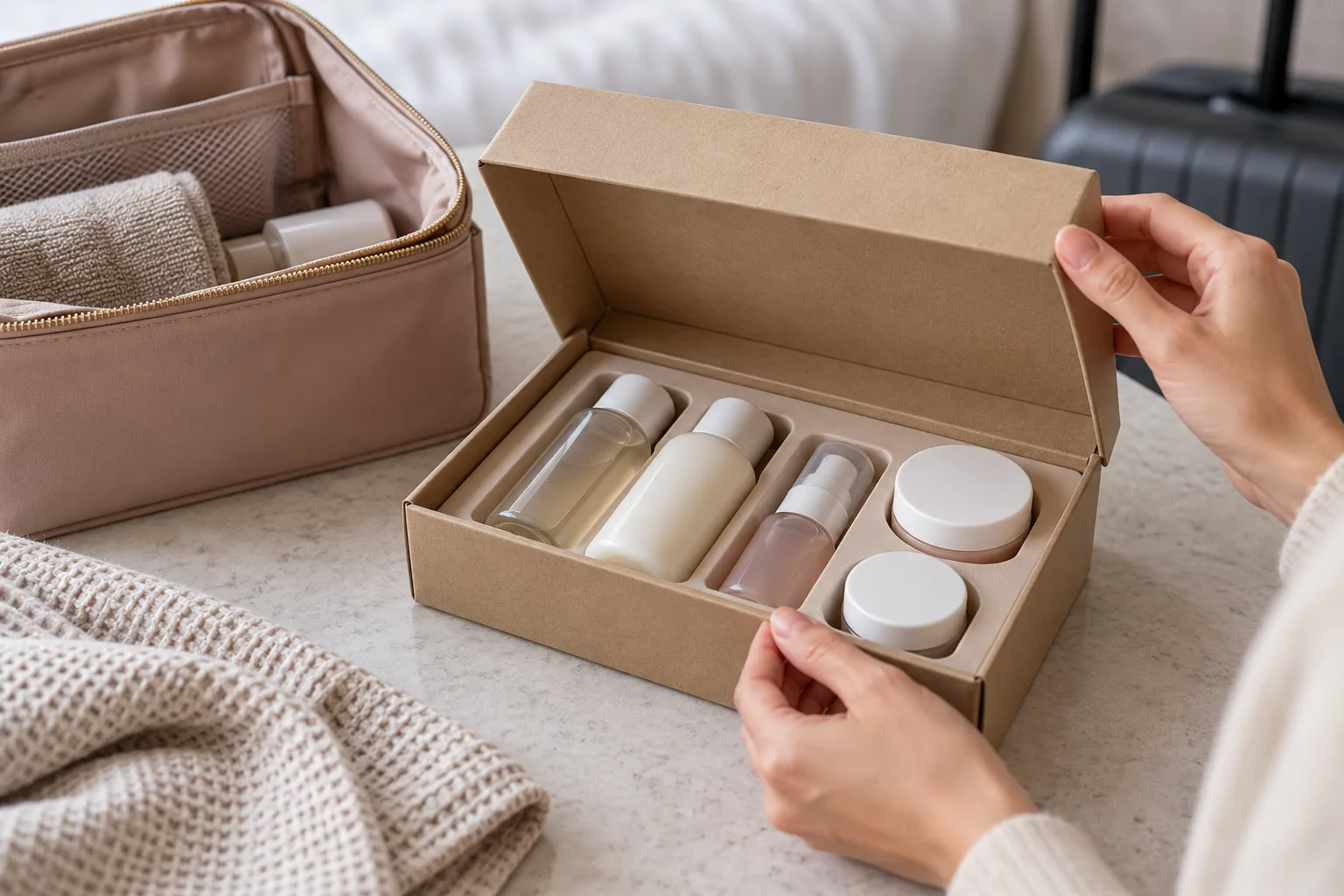
We retain a useful physical reference
We do not treat a travel-size set as a single paper box. It is a small packaging system. The primary containers hold the formula. Closures control resealing. Labels identify the product. The carton groups and presents the set. An insert can control internal movement. A separate mailer or protective layer can address the delivery route. When the team reviews only the outer carton, problems can remain hidden until packing. We assemble the intended version and open it as a customer would. We check that the closures do not press against the board, the card does not buckle, printed labels remain visible, the box closes normally, and the products can be lifted without excessive force.
We then record the component versions and open points. A change in cap height, bottle shoulder, label material, insert board, or card thickness can change the result. We do not claim that a sample proves leak resistance or airline acceptance. Those questions belong to the relevant formula, closure, transport, and route owners. We can, however, show whether the physical system fits and presents as designed. Community posts about travel containers mention both preferences for original mini packaging and concern about leaks or hard-to-use formats. That is a helpful qualitative clue, not a representative survey.
We use it to make the sample review more practical: does this exact set feel easy to use, identify, close, and carry in its stated packaging role? A retained approved set gives the next production run a much clearer answer than a generic product mockup.
Sources for this section: Reddit travel beauty-packing discussion3, Finer Pack packaging samples5, Contact Finer Pack6
| Review point | What the sample can show | What remains separate |
|---|---|---|
| Opening | Access and return of each item | Consumer preference at scale |
| Fit | Container, card and insert relationship | Long-term formula compatibility |
| Closure contact | Visible pressure points | Leakage qualification |
| Outer protection | Planned role in the route | Carrier or security approval |
Sources and Related Reading
- 1 TSA carry-on liquids guidance. Primary U.S. passenger-screening context; it does not approve cosmetic packaging or replace route-specific confirmation.
- 2 Amazon airless-container keyword page. Marketplace keyword-language signal for airless-container terms; listed figures are not used as sales claims.
- 3 Reddit travel beauty-packing discussion. Attributed community discussion about minis and decanting, not a representative survey or safety source.
- 4 Finer Pack folding cosmetic cartons. Internal route for compact carton structure and artwork planning.
- 5 Finer Pack packaging samples. Internal route for complete packed-set review.
- 6 Contact Finer Pack. Internal route for a compact-set structure and sample brief.
Conclusion
We make travel-size beauty sets useful by fitting the real containers first, giving each piece a clear position, and approving the complete packed sample.