
Gift & Unboxing guide
How Do We Design a Fragrance Discovery Set Insert?
Small fragrance samples can look considered in a flat lay yet become loose, hard to remove, or hard to identify when the insert ignores the opening sequence.
We design the insert around the actual vial, cap, label, sequence, and opening motion. We give each sample a secure cavity with deliberate removal space, then review the complete set, card, presentation box, and delivery layer together.
We use three questions to turn a fragrance discovery set insert and its samples into a physical experience without promising performance that has not been tested.
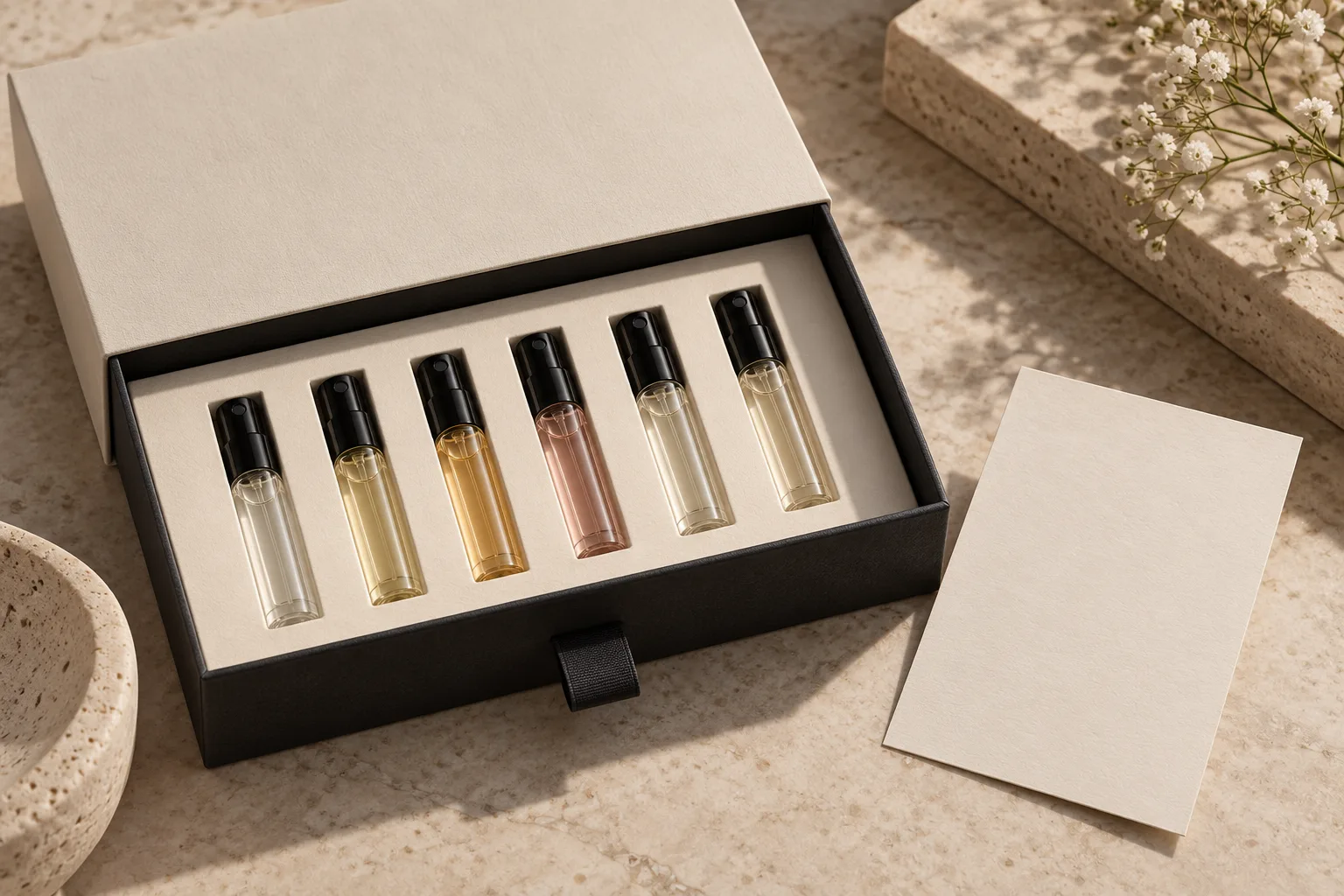
What Does the Insert Need to Hold?
A cavity cut from a nominal vial size can pinch a cap, hide a label, or let a slightly different component tip inside the box.
We measure the filled sample, cap, label zone, and any protective sleeve before we draw the cavity. We also define how a person removes each vial. The insert must control movement without turning first use into a struggle.
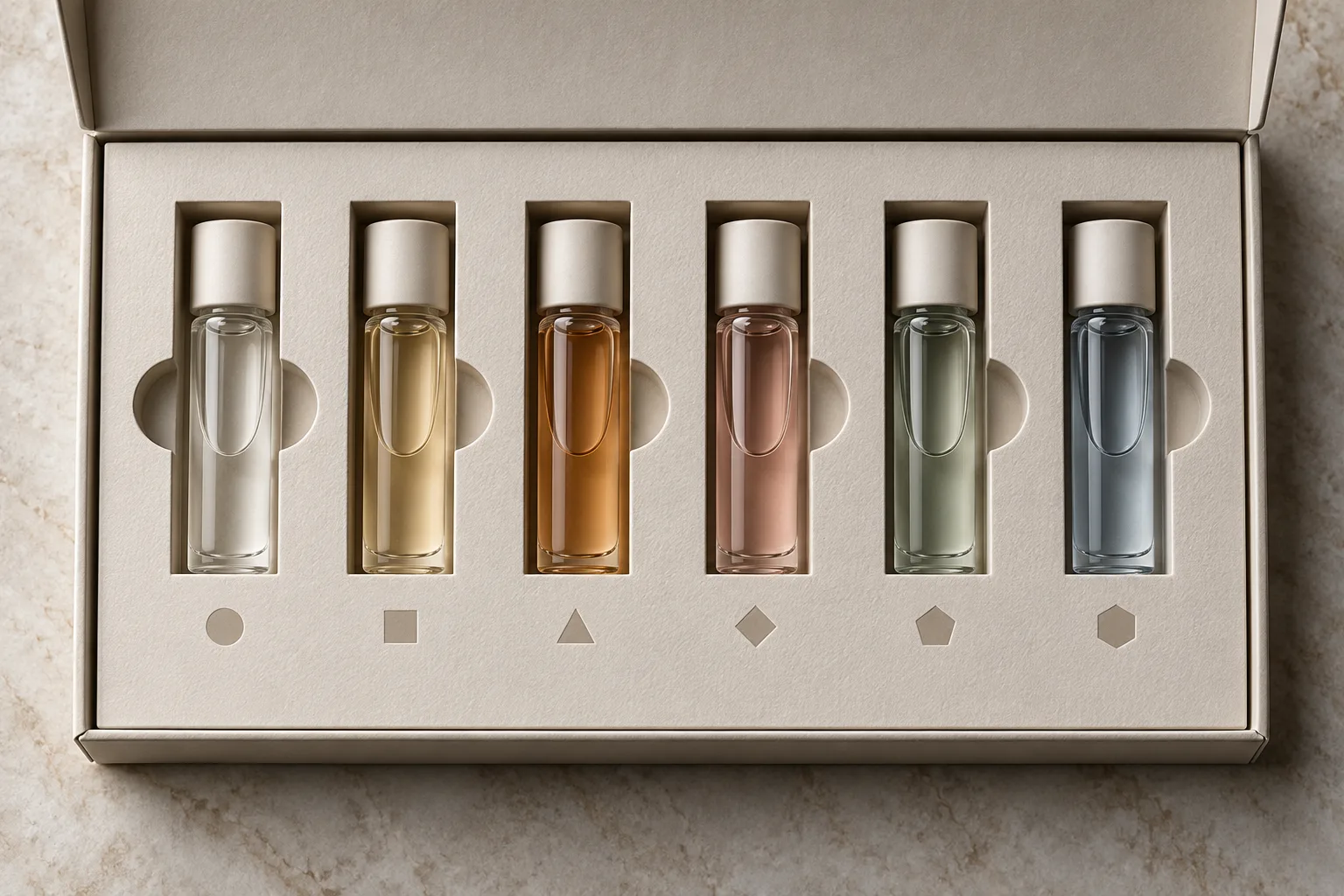
We measure the complete sample, not a catalogue outline
We ask for real components whenever possible. The vial body is only one part of the package. A spray cap, collar, label seam, tamper band, and filled weight can change the space needed in a cavity. We record the largest relevant dimensions and the direction the vial will sit. We then decide where a person will place a finger or thumb to lift it. A very tight cavity can look refined in a render but frustrate someone who cannot grip the glass. A very loose cavity can let samples knock together, especially when a set is carried or shipped. We use a structural sample to balance those two risks.
The customer should be able to identify the sample, lift it without scraping the label, return it if the set is meant to be stored, and close the box without forcing the lid. We also think about the full range. A discovery set may have five, six, or more vials. If every position looks identical, the order has to come from a card, a number, a colour system, or a clear physical map. Etsy search listings currently use terms such as perfume sample set, discovery kit, gift box, and choose-your-scent. Those listings are language signals, not sales evidence or a specification for our client.
They tell us that buyers will encounter sets with different counts and gift framing, so the brief must name the exact selection and count. We do not borrow another seller's visual system. We build a cavity and card sequence for the actual product range.
Sources for this section: Etsy perfume discovery-set packaging search1, Etsy perfume discovery box search2, Contact Finer Pack6
| Insert input | Why it matters | Simple check |
|---|---|---|
| Filled vial and cap | Sets cavity size and height | Close the real set |
| Label zone | Keeps identification visible | Lift without scraping |
| Removal space | Controls first use | Try with normal fingers |
| Set count | Defines the information order | Match every position to a card |
How Should We Sequence the Samples and Information?
A beautiful outer box cannot help a buyer compare scents when the vials, names, and guidance have no clear relationship.
We give each physical position one stable identity. The insert, vial label, and information card use the same order. We leave room for a future variant only when the brand has defined how that variation will be communicated.
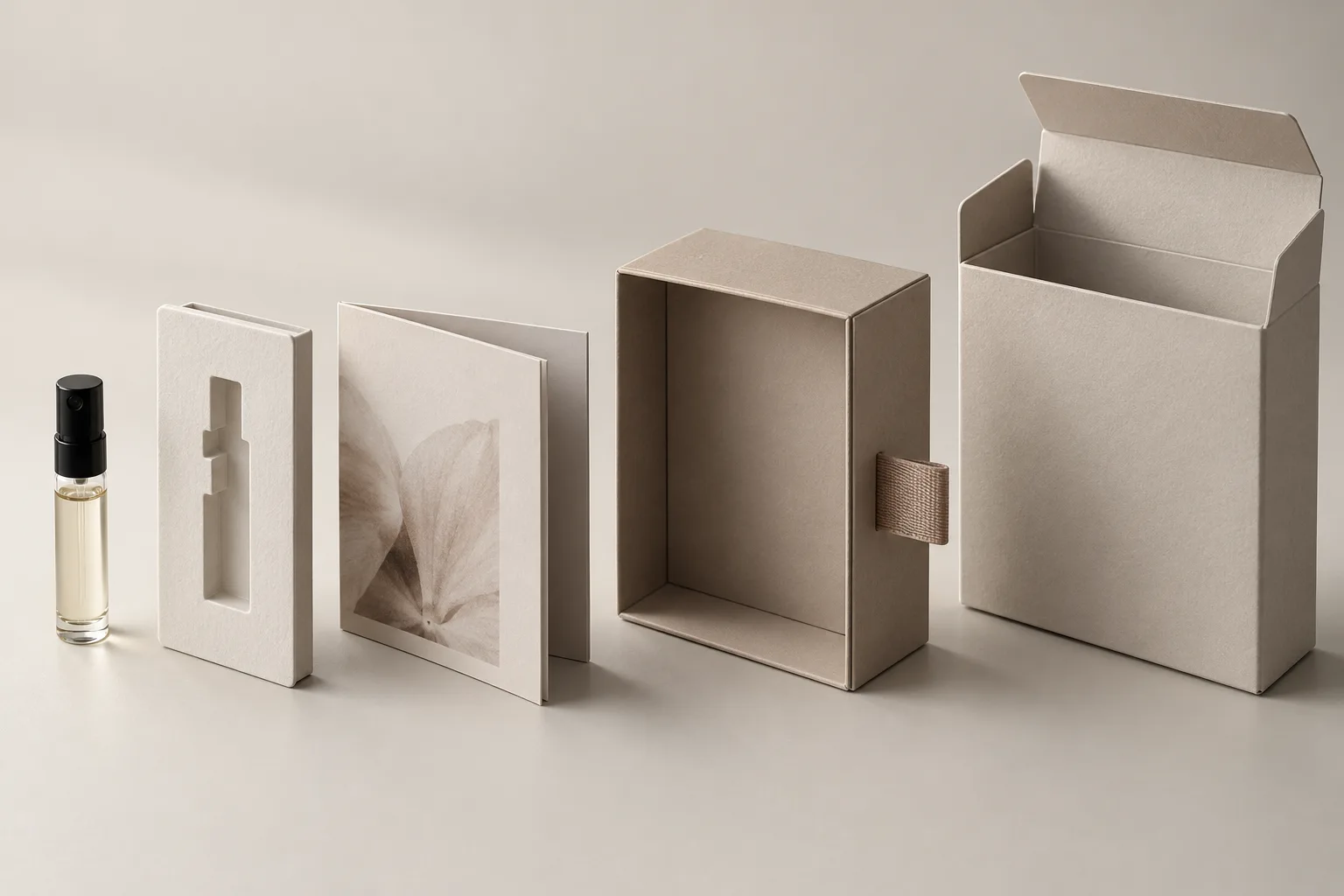
We let the physical order answer the first question
We decide what the set is asking a person to do. It may invite a shopper to compare a signature range, try samples before choosing a larger fragrance, give a compact gift, or keep a personal collection organised. That goal changes the sequence. A discovery journey can move from light to deep notes. A gift set can use a visual order that matches a card. A flexible build-your-own set needs an accurate pick record before it reaches the insert. We do not rely on memory or a decorative pattern to carry the identity. Each vial needs a clear product identifier supplied and approved by the brand.
The card can add scent family, use guidance, or a next step, but it should not be the only place that tells the customer what they hold. A recent Reddit discussion in r/Perfumes about displaying discovery sets drew attention to the wish to keep samples accessible rather than buried in a collection. That is a community clue, not a market survey. We use it to ask an operational question: after the first opening, can a customer find and return one sample without emptying the whole tray? We also plan for relabels and formula or range changes. If the carton artwork has a fixed printed sequence, a removed SKU can turn into dead space.
If the brand expects frequent changes, a simpler insert plus a controlled card or label may be better. That tradeoff belongs in the brief before a complex finish or high-cost tray is chosen.
Sources for this section: Etsy perfume discovery box search2, Reddit fragrance discovery-set discussion3, Finer Pack drawer boxes4
| Information layer | Job | Control point |
|---|---|---|
| Vial identifier | Names the physical sample | Match approved range list |
| Insert position | Keeps sequence stable | Number or map each cavity |
| Card | Adds comparison context | Match the physical order |
| Outer box | Sets gift and shelf presentation | Do not make it the only identifier |
What Should We Sample Before Releasing the Set?
A tray that holds empty vials on a desk may behave differently once products are filled, cards are added, and the set is packed for delivery.
We sample the complete configuration: filled vials, insert, card, presentation box, closure, and outer protection. We record what the sample demonstrates and route any formal shipping or fragrance requirements to the responsible owner.
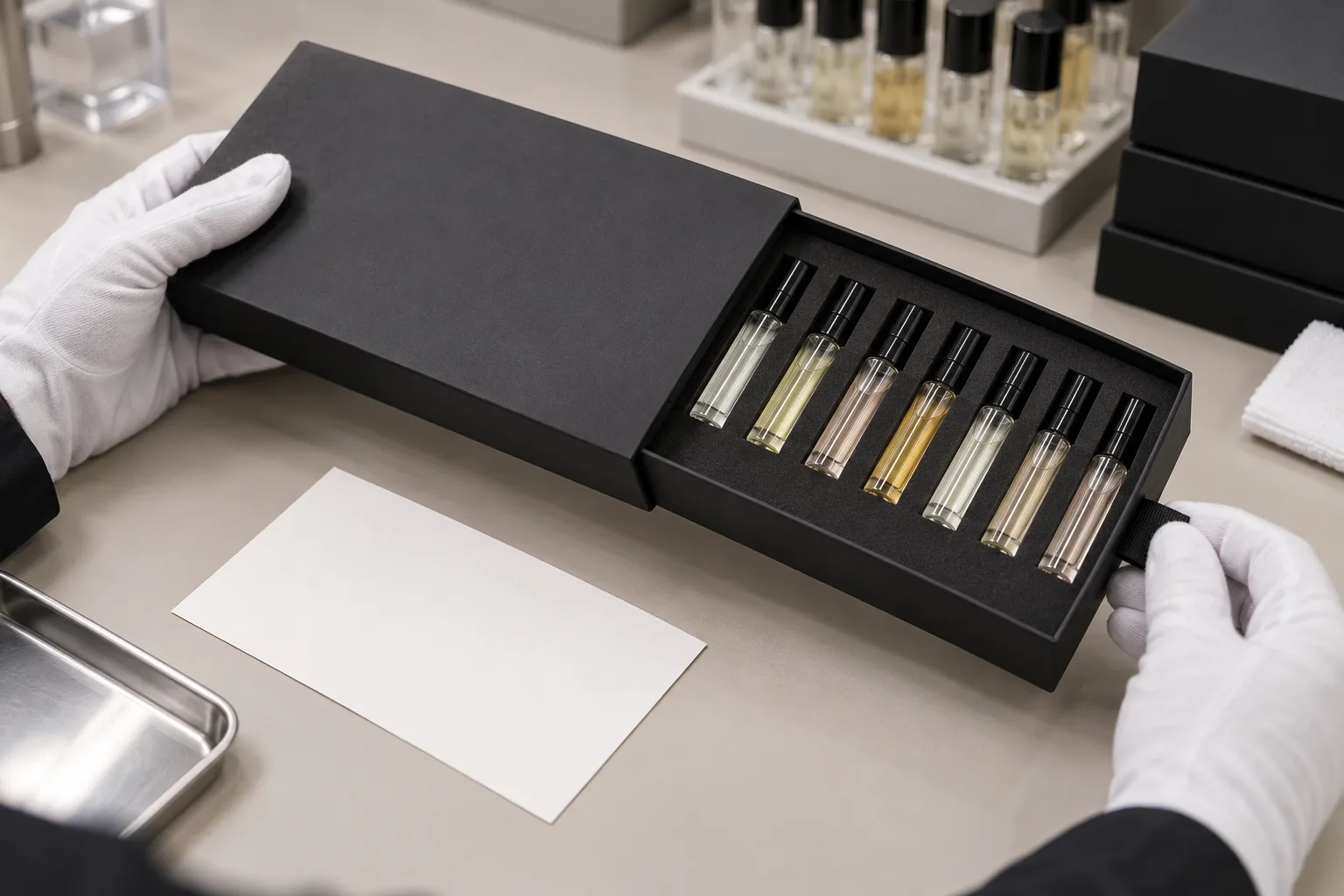
We approve the set as a system
We separate presentation decisions from handling decisions. The inner insert keeps vials in order and can provide a deliberate reveal. The presentation box protects the set's appearance and carries the primary gift experience. The outer delivery layer manages the route beyond the product box. A discovery set may need all three, or it may need only some of them. We do not automatically add layers because another brand uses them. We build the physical sample with the intended vial count, actual caps, filled condition, printed card, and finished outer box. Then we open and close it repeatedly, lift each sample, confirm that the card fits without bending, and inspect where glass or caps touch the insert.
If a set is intended for parcel delivery, we agree which physical route and acceptance points matter. Our sample can show fit and presentation. It does not prove a named carrier rule or a formal test result unless the relevant owner has arranged that test. This boundary matters particularly for alcohol-based fragrance, where shipment conditions and market rules may need separate review. We retain a reference sample and identify the version of each component, because a new vial supplier, cap height, insert board, or added card can change the system. We also use customer discussion with care. A Reddit post about sample collections being hard to organise is not evidence that every discovery set needs a permanent display tray.
It is a useful prompt to decide whether our own set should support re-storage. The answer should come from the brand's purpose and the complete physical sample.
Sources for this section: Reddit fragrance discovery-set discussion3, Finer Pack packaging sampling5, Contact Finer Pack6
| Sample layer | What we review | What needs separate evidence |
|---|---|---|
| Insert | Fit, removal and return | All shipment outcomes |
| Presentation box | Opening and visible condition | Carrier acceptance |
| Card | Order and physical fit | Product claims |
| Outer pack | Protection role and orientation | Formal transport compliance |
Sources and Related Reading
- 1 Etsy perfume discovery-set packaging search. Marketplace-language signal for discovery-set and sample-packaging terms; not sales or quality evidence.
- 2 Etsy perfume discovery box search. Marketplace-language signal for discovery-box, sample and packaging terminology; not a product-performance source.
- 3 Reddit fragrance discovery-set discussion. Attributed community discussion about displaying and retaining discovery samples, not a representative preference study.
- 4 Finer Pack drawer boxes. Internal route for presentation-box structure and opening considerations.
- 5 Finer Pack packaging sampling. Internal route for complete-set sample planning.
- 6 Contact Finer Pack. Internal route for a vial, insert, presentation-box, and delivery brief.
Conclusion
We make a discovery set easy to compare by designing its vial cavity, sequence, information and full packed sample as one system.